 Skipper
Nautical glossary for people who sail
The words, in plain English, with the folk etymologies cleared out. Most of what circulates about where nautical words come from is wrong, and some of what circulates about what they mean is too. Checked against primary sources in October 2026.
Where an origin is genuinely unknown, it says so. Sailing is full of confident explanations passed down for two hundred years, and the honest answer is often that nobody knows.
A
- Ashore
- On land, or on the beach. Not a shore. Boats go ashore; the feature they are not is a shore.
- Anchorage
- A place where a vessel can anchor, and the act of doing it. Also used loosely for the mooring itself.
- Aground
- Stuck on the bottom, or on a shoal. Distinct from ashore: aground means touching bottom, which may still be under water.
B
- Beam
- The widest part of the vessel, measured across her. A sea or wind on the beam hits you on the side.
- Bilge
- The turn of the hull where the side becomes the bottom, and the compartment inboard of it where water collects. From Old English bulge, ultimately from a word for a leather bag.
- Bow
- The front of the vessel. Port and starboard are defined facing the bow, which is why “port” and “left” only agree if you know which way is which.
C
- Cable
- Originally the anchor chain, and the unit of chain you paid out when anchoring. As a distance, a cable is a tenth of a nautical mile, about 185 m, today — but it used to be ten fathoms, or 120 ft, about 36.6 m. Across the sources it runs from roughly 169 to 220 m, so say which convention you mean. See the fathom.
- Cabin
- Any enclosed accommodation space, not necessarily the sleeping quarters, which is the berth and sometimes the bunk.
- Capsize
- To lose the boat. In British usage capsize usually means the boat turned fully upside down; heel is the everyday word for leaning.
- Centre of effort
- The point where the combined pull of all the sails appears to act. Move it too far forward and the boat noses down; move it aft and she will round up. Most reefing and sail-trim decisions are really decisions about this point.
- Course
- The direction you are steering, which is not the same as the direction you are actually travelling. Current and leeway make those diverge. See leeway.
D
- Dead reckoning
- Working out where you are from where you were, your course and your speed, without help from the sun, a landmark or a satellite. Still used to check other navigation, and still worth doing when you are tired.
- Dog watch
- Two short watches, 1600–1800 and 1800–2000, splitting one four-hour evening watch in two. The purpose is documented: seven periods a day instead of six, so the rota rotates. The name is not — “dodging the watch” and Sirius the Dog Star are both undocumented.
- Drift
- The speed of the water past you, as distinct from set, its direction. Not to be confused with leeway, which is the wind pushing you sideways off your course.
F
- Fathom
- Exactly 6 feet, or 1.8288 m — not approximately, the figure is exact. From Old English for the outstretched arms or embrace, which is where you get the sense of measuring something by spanning it. One cable used to be ten of them.
- Flood
- Water coming in, as a tide. Maximum flood is the moment of strongest flow, which is not the top of the tide. See tide.
- Following sea
- Waves running from behind you, which push the boat along and can make her surf. The opposite, and the dangerous one, is the head sea.
G
- Ground tackle
- Everything that holds a boat: anchor, chain, rode and the fitting they attach to.
- Gunwale
- The top edge of the side, where deck meets hull. Not, despite appearances, a line for firing guns: the word means “gun platform” — a gun plus Old English wale, meaning a plank. Also spelled gunnel.
- Gybe
- Changing tack by turning the stern through the wind, so the boom swings across from one side to the other and can knock people down. Compare tack. Also spelled jibe.
H
- Hatch
- An opening in the deck, and the cover over it. A companionway is the way you get through one; companion hatch is the older term for the same thing.
- Head to wind
- Pointed into the wind, which is when a boat has least steerage and least speed. The moment inside a tack, when the boat is head to wind, is when it is least under control.
- Heel
- The sideways lean of a boat, from wind or from turning. In British use capsize usually means fully inverted, so the two are kept apart.
- Hold
- The storage space inside the hull. Originally it meant all the space below the orlop deck — the upper deck above it, sometimes spelled orlop, is the one below it.
K
- Keel
- The spine of the boat, lowest part of her structure. The word originally meant the part that keeps a ship steady, from a root meaning to stand or be firm.
- Knot
- One nautical mile per hour, exactly, named for the knotted line of the log. Singular and plural alike. Knots per hour is meaningless — a speed per hour is an acceleration. Before 1954 the American nautical mile was 6080 ft, so old books need converting.
- Knows
- In “the captain knows”: a decision made without discussion. The idiom is real; the maritime story behind it could not be traced to any source, so treat it as folklore.
L
- Larboard
- The old word for the left side, replaced by port. Not a decision about tidiness: the two words sounded too much alike for reliable use at sea, and larboard was abandoned by order of the Admiralty well before 1867.
- Leeward
- Away from the wind. The opposite of weather. Only windward has a traceable root; the root of lee is not settled.
- Leeway
- Either the sideways movement caused by wind, or the distance that movement costs you. Different from drift and set, which describe the water rather than the wind.
- Log
- The instrument: a wooden chip streamed astern on a knotted line, timed with a sandglass to measure speed through the water. In British use log still means this; in American use it often means the record. Same object, hence the permanent confusion.
- Log line
- The knotted line of the log. Its marks were a convenient fraction of a mile — commonly eight fathoms — checked against a sandglass. No two ships did it identically, so any figure you read is one ship’s convention, not a definition.
- Logbook
- The written record of a vessel’s voyages, entered watch by watch. Younger than the instrument it is named for by about a century: the chip log is documented from 1574, the word logbook from the 1670s. See what to write in one.
M
- Manifest
- List of what is aboard. A customs manifest is the one borders care about.
- Mark
- A fixed navigation mark, or the act of identifying one. A buoy on a chart can be a lateral mark, a cardinal mark or a safe-water mark, and the shape and colour tell you which.
- Middle watch
- The midnight-to-0400 watch in the traditional system, the one everyone dreads. Usually split into two four-hour turns rather than one eight-hour one.
- Moor
- To secure a boat, whether with anchor, lines or something else. In British usage mooring is the fixed structure or buoy you secure to, and a mooring buoy is a floating one.
- Mother
- The anchor currently holding the boat, in phrases like let go the mother. The “she holds the ship” explanation is a mnemonic, not an etymology.
N
- Nautical mile
- Exactly 1852 m, or 6076.11549 ft, agreed in 1929. Not an SI unit, and with no single agreed abbreviation. Two traps: British legal conversions use 1853 m, and the US used 6080 ft until 1954. One nautical mile is 1.1508 statute miles.
- Anything used to fix your position by sighting it: a buoy, a beacon, a light, a leading transit or a conspicuous object ashore. Also called an aids to navigation, or simply aids.
P
- Port
- The left-hand side of a vessel when aboard and facing the bow. Its origin as a directional word is not established. It is a separate word from the harbour sense of port, which genuinely comes from Latin portus; the idea that the left side is named for the harbour you berth on is a folk explanation that has been repeated for so long it appears even on NOAA’s public pages.
- Preventer
- A line or fitting that stops something moving. A boom preventer holds the boom down on a run; a prevents or snatch block can save a dropped halyard or a fallen mast.
R
- Reef
- Two words, one spelling, one root. A reef is a shallow danger; to reef is to shorten sail early. Both from Old Norse rif, a rib or ridge — a rare case of a rock and a sail from one root.
- Reefing
- Reducing sail before the wind gets strong, rather than after. The decision is about where you will be and what you will have to do later, not about what the boat feels like now.
S
- Scupper
- An opening in the deck that lets shipped water run overboard. Its origin is genuinely uncertain: several plausible derivations exist and no dictionary treats any as settled, so you will see confident answers that are really guesses.
- Sea state
- The condition of the surface, and the Douglas Sea Scale is the proper scale for it: ten degrees, 0 to 9, glassy to phenomenal. It has two codes — one for wind sea, one for swell — which are not the same thing.
- Set
- The direction the water is flowing. Together with drift, its speed, it tells you the whole story of the current. Neither word describes the boat: leeway is what the wind does.
- SOG and STW
- Speed over ground is how fast you are actually moving across the seabed. Speed through water is how fast you are moving through the water itself, and is the true measure of the boat’s performance. They differ by the current. A logbook that records only one of them is ambiguous about the other.
- Starboard
- The right-hand side when facing the bow. From Old English steorbord, “steer-board”. The story that it is star plus board is a later invention, kept alive because the Icelandic cognate does contain the word for star.
- Stbd
- The written abbreviation, always with no vowels. Likewise aft, fwd, port as P. Handy in a logbook column heading.
- Swell
- Waves not from the wind now blowing — left over from a distant storm. Height, period and direction are separate facts. A long low swell tires a boat more than a short steep chop, because she keeps getting lifted onto it.
- Stern
- The back of the boat. In a gybe the stern is the end that comes through the wind.
T
- Tack
- Changing sides by putting the bow through the wind, so the headsails fall aback and you lose steerage for a moment. This is the normal way to work to windward. Compare gybe, which puts the stern through instead. The word also means the lower forward corner of a sail, and, separately, the ship’s biscuit.
- Tide
- The water going up and down: the vertical part of the tidal wave. The horizontal part is the tidal current. Both come from the same pull of Sun and Moon, so they are two halves of one wave, which is why they do not peak together.
- Tidal current
- Water moving sideways because of the tide, called tidal stream in British usage. Slack at high and low water is true in some places and wrong in others: on an open coast the current peaks about three hours after high water, while a gulf that fills as one body goes slack at high and low water. See tide vs current.
- Slack water
- The moment a reversing current stops and changes direction. Never assume it coincides with high or low water — see tidal current.
- Trim
- How a boat is balanced fore and aft, and by extension how she is balanced in any other axis. Boats that sail bow-down in a swell want weight moved aft.
- Turning circle
- How much room a boat needs to come about. Under sail it depends on speed and sea room; under engine it depends on the rudder, the speed and the propeller.
V
- Visibility
- How far you can see. It drops first when fog comes in, often before the wind changes. Records of it are more useful in aggregate than in the moment: six months of them shows which months your coast disappears.
- Veer
- A shift of wind further aft — north-east to east is veering, the opposite is backing. A backing wind tends to bring worse weather with it.
W
- Watch
- A turn of duty at sea, and the crew who stand it. Traditionally six watches a day, with the evening one split into two dog watches to make seven, so the hours rotate instead of standing still. Note that a watch is the turn, a watchkeeper is the person, and watch time is measured in bells: six bells end a watch, eight begin one.
- Weather
- The side the wind comes from, and the hard side to be caught on. Note that the opposite of lee is weather, not “wind”.
- Wind force
- The Beaufort number, 0 to 12. It measures the appearance of the sea, not wind speed — devised around 1805 from how much sail a warship could carry. The knots were derived later and never made official. See wind force.
Commonly confused
Five things boaters are confidently wrong about
“Starboard is star plus board.”
No. It is Old English steorbord, “steer-board”. The story has no source, and survives because the Icelandic cognate stjórnborði really does contain the word for star.
“Port is the harbour side.”
Unestablished. Port the direction is a separate word from Latin portus, which cannot mean “left” anywhere. The loading-side story has repeated for so long it now appears on government pages.
“The current is slack at high and low water.”
Sometimes. On an open coast the current is strongest about three hours after high water; in a gulf or estuary that fills as one body it does go slack at high and low water. That difference decides whether a tidal gate is passable. The related “age of the tide” figure of fifty-odd minutes is a different thing entirely: a beat between the lunar and solar constituents, not a delay between the moon and the sea.
“Leeway is the current.”
Leeway is the wind on the hull; set and drift are the water moving. A logbook recording only “speed” cannot tell them apart, which is why SOG and STW are worth separating.
“The dog watch is named after a dog.”
The practice is documented; the name is not. “Dodging the watch” and Sirius the Dog Star both appear in no period source.
Where these words go
The ones your logbook actually holds
Some of this vocabulary exists because somebody had to write it on paper. The entries a skipper keeps are the conditions and the decisions: wind force and its direction, sea state, swell,tidal current, visibility, day or night, sail or motor or both, engine hours, and who stood which watch.
The first group is measured for you. The second is judgement, and judgement is the part a chartplotter has no opinion about.
- Records itself once the boat leaves the berth, with no signal needed
- Attaches the weather, wind force and direction for that time and place
- Sea state, crew, engine hours and anything that broke are yours to write
- Kept on your device, exportable as GPX whenever you want it elsewhere
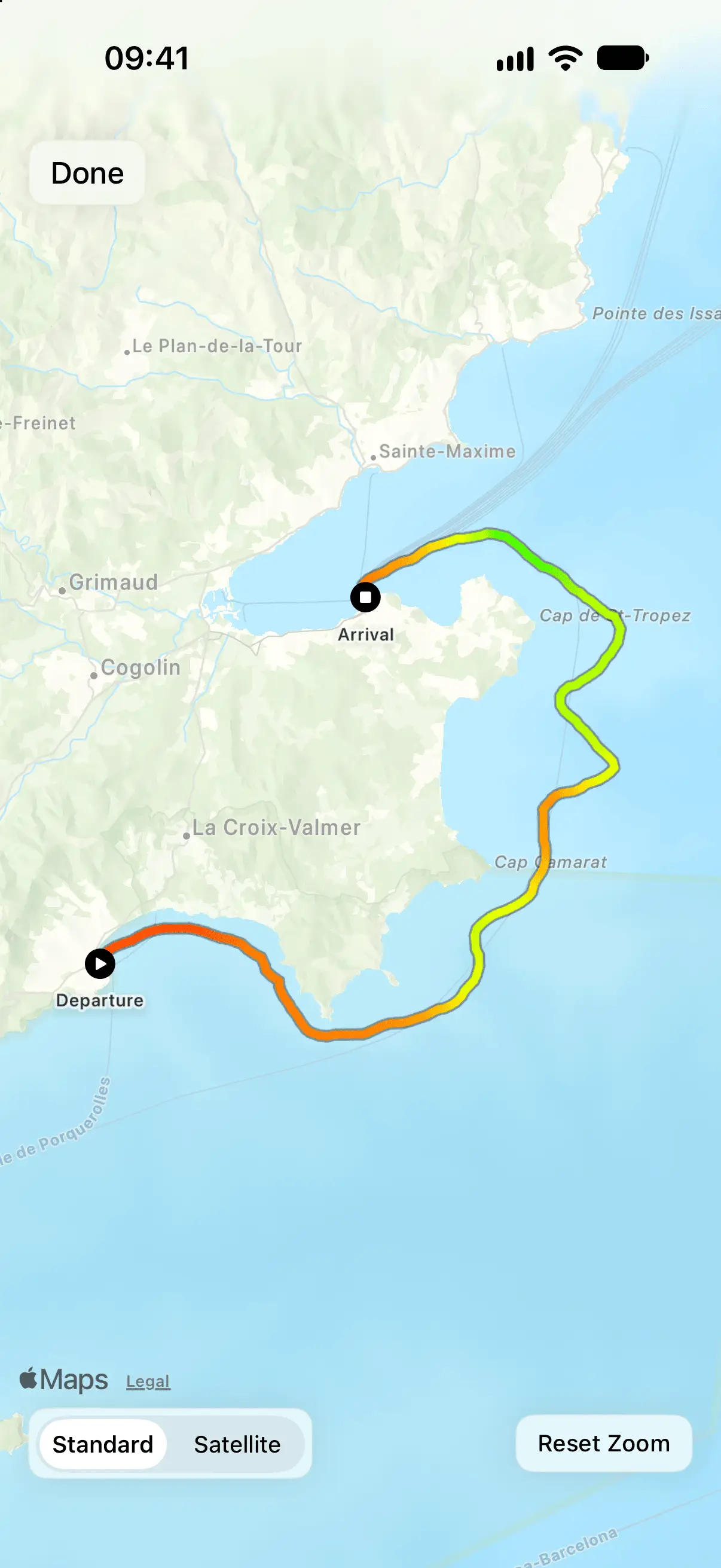
Remember your days at sea
Skipper is a ship’s log app for sailboats and powerboats, available on iPhone and iPad. It records every trip with GPS and keeps your whole sailing history in one searchable logbook. Free for your first three trips.