 Skipper
Navigate
•All boatersBoat Navigation Lights Explained
Learn how to identify boat navigation lights, understand what they reveal about a vessel, and recognise the lights required at night and in restricted visibility.
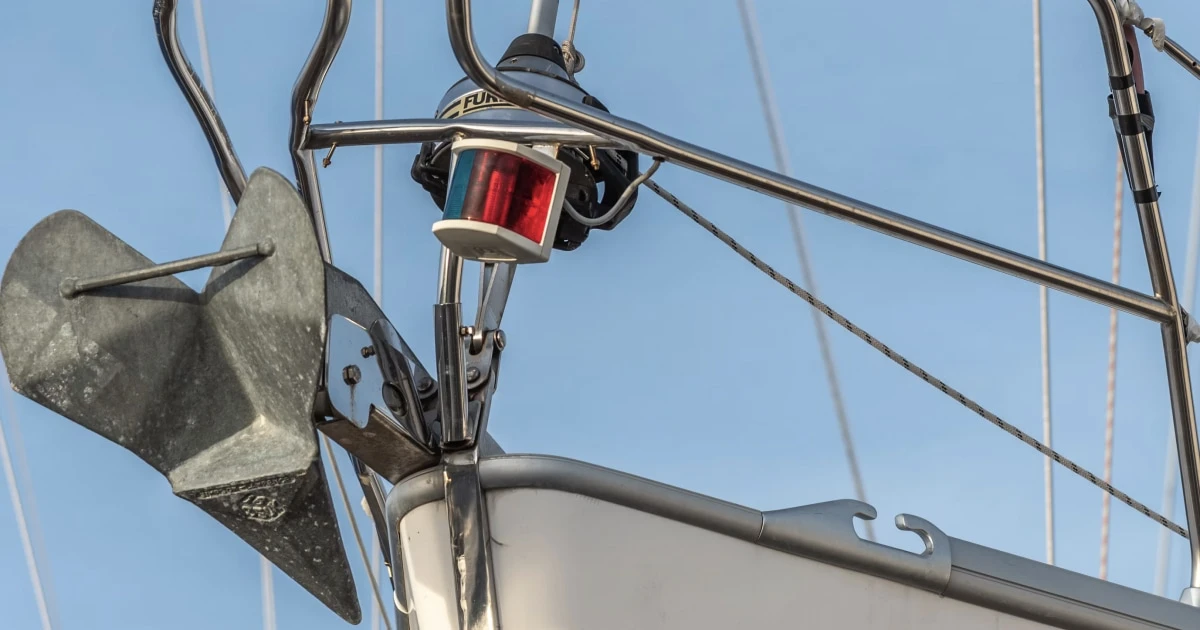
Boat Navigation Lights Explained
You are sailing after sunset and spot a white light ahead, with a red light appearing briefly to one side. Is the other boat heading towards you, crossing your route, or moving away?
Navigation lights are essential for answering these questions. They help you identify a vessel’s orientation, propulsion, and sometimes its operational status when you cannot rely on daylight or a clear view of the hull.
Under the International Regulations for Preventing Collisions at Sea (COLREGs), navigation lights follow standardised colours, sectors, positions, and visibility ranges. Learning to recognise the main patterns helps you interpret what you see and make safer decisions.
This guide explains the main navigation lights used by recreational boats, how to interpret common configurations, and what to check before navigating at night.
1. What are boat navigation lights?
Navigation lights are prescribed lights displayed by vessels to communicate information about their orientation and status to other water users.
The COLREGs establish requirements for when lights must be displayed, their colours and sectors, their positions, and their minimum visibility ranges. The exact configuration depends on factors such as:
- Whether the vessel is power-driven or sailing.
- Whether it is underway, anchored, or aground.
- Whether it is towing or pushing another vessel.
- Whether it is engaged in fishing.
- Whether it is not under command or restricted in its ability to manoeuvre.
- The vessel’s length and other circumstances specified by the rules.
Navigation lights are not simply decorative markers. Their purpose is to help other vessels assess a situation and apply the appropriate collision-avoidance rules.
The main international requirements are found in COLREG Rules 20–31, supported by Annex I, which specifies technical details and positioning.
2. The five main types of navigation lights
Most common navigation-light configurations are built from five basic types of light.
  <text color="secondary" size="sm">Red on port, green on starboard.</text>

  Each sidelight covers 112.5 degrees, from directly ahead to 22.5 degrees abaft the beam on its respective side. Together, they help indicate which side of a vessel you are seeing.
</box> <text color="secondary" size="sm">White light visible across the forward sector.</text>
It covers 225 degrees, from directly ahead to 22.5 degrees abaft the beam on each side. It is used in configurations prescribed for power-driven vessels and certain other vessel operations.
</box> <text color="secondary" size="sm">White light visible from behind.</text>
It covers 135 degrees, centred on the stern. It helps another vessel recognise that it is viewing the rear of a boat.
</box> <text color="secondary" size="sm">Visible through 360 degrees.</text>
An all-round light can be white, red, green, or yellow, depending on its purpose. An all-round white light is commonly associated with anchoring on smaller recreational vessels, but other configurations are possible.
</box> <text color="secondary" size="sm">Yellow light with the same sector as a sternlight.</text>
A towing light is yellow and covers 135 degrees. It is used in prescribed towing configurations and must be interpreted together with the vessel's other lights.
</box>The meaning of a light depends on its colour, sector, position, and combination with other lights. Never identify a vessel solely from the fact that you can see a white, red, or green light.
3. Red and green lights: which side of the boat are you seeing?
The two sidelights are among the most useful clues when interpreting another vessel at night.
- Red means port: the vessel’s left side when facing forward.
- Green means starboard: the vessel’s right side when facing forward.
These colours are fixed by the COLREGs and do not change between IALA buoyage Regions A and B.
Seeing a red light
If you see the red sidelight of an approaching vessel, you are observing its port-side sector. Depending on the relative positions and movement of the vessels, the other boat may be crossing your route or approaching from another angle.
The red light alone does not tell you whether a collision risk exists. You need to assess the bearing, movement, and surrounding traffic.
Seeing a green light
If you see the green sidelight, you are observing the vessel’s starboard-side sector.
Again, this is only one part of the picture. The relative bearing and whether the other vessel’s bearing is changing are important when assessing collision risk.
Seeing both red and green lights
When both sidelights are visible, you may be looking towards the forward sector of the vessel, although the precise interpretation depends on the angles and visibility of the lights.
For a standard head-on encounter between two power-driven vessels where collision risk exists, Rule 14 generally requires both vessels to alter course to starboard. However, do not decide that a situation is head-on simply because you can see both colours. Confirm the circumstances and apply the relevant COLREG rules.
4. Power-driven vessels underway
A power-driven vessel underway generally displays:
- A forward masthead light.
- Sidelights.
- A sternlight.
A power-driven vessel 50 metres or more in length must generally display a second masthead light abaft of and higher than the forward one. There are additional requirements and alternatives for some vessels and circumstances.
For power-driven vessels less than 12 metres long, the COLREGs permit certain alternative arrangements, including an all-round white light and sidelights. The precise permitted arrangement depends on the vessel’s length and the applicable rule.
How to interpret the lights
A masthead light visible ahead, together with sidelights, can indicate that a power-driven vessel is approaching or crossing your field of view. A sternlight without sidelights can indicate that you are viewing the vessel from behind.
However, this is not a complete identification method. Other vessel types may show white lights, and special circumstances can require additional lights.
The COLREGs specify what the vessel must display; they do not guarantee that every light will be visible to you in every situation.
5. Sailing vessel navigation lights
A sailing vessel underway generally displays:
- A red port sidelight.
- A green starboard sidelight.
- A white sternlight.
An approved combined lantern may be used where permitted, showing the red, green, and white sectors from a single unit at or near the masthead. Its use must comply with the applicable requirements and it must not be displayed in conjunction with separate sidelights where the rules prohibit that combination.
What if a sailboat is using its engine?
A sailing vessel using its engine for propulsion is treated as a power-driven vessel under the COLREGs, even if its sails are still raised.
This is an important distinction. The vessel’s displayed lights must reflect its status under the rules, not simply the fact that it has sails.
Small sailing vessels
The COLREGs provide specific provisions for sailing vessels less than 7 metres long and for vessels under oars where the standard lights may not be practicable. These provisions have conditions and should be checked against the current rules.
Do not assume that a small boat is automatically exempt from showing lights at night.
6. Towing and pushing vessels
Towing operations can require additional lights because the configuration and length of the tow affect how the vessels should be interpreted.
A towing vessel may display:
- Two masthead lights in a vertical line, or three when the length of the tow exceeds the threshold specified in Rule 24.
- Sidelights.
- A sternlight.
- A yellow towing light above the sternlight.
The exact arrangement depends on the type of towing operation, the length of the tow, and whether vessels are being pushed ahead or alongside.
A vessel being towed also has prescribed lighting requirements. In some cases, additional lights or alternative configurations are required, especially where the tow is partly submerged or otherwise difficult to see.
Why towing lights matter
A tow can extend a considerable distance behind the towing vessel. If you see a towing light, do not assume that the water immediately behind the vessel is clear.
Keep a safe distance and assess the complete configuration. A tow may be difficult to see at night, and its length and movement can make close manoeuvres hazardous.
7. Fishing vessels and vessels with restricted manoeuvrability
Some vessels display special light configurations that indicate their operational status.
Fishing vessels
Vessels engaged in fishing have specific light requirements under Rule 26. The configuration depends on the type of fishing and whether the vessel is making way through the water.
A vessel engaged in trawling generally displays a different combination from a vessel fishing by methods other than trawling.
These lights are not a generic sign that a vessel is working or moving slowly. They communicate a defined status under the COLREGs.
Vessels not under command
A vessel not under command because of exceptional circumstances that prevent it from manoeuvring as required by the rules generally displays two all-round red lights in a vertical line. If it is making way through the water, additional sidelights and a sternlight are prescribed.
This configuration signals that the vessel cannot manoeuvre as required by the COLREGs.
Vessels restricted in their ability to manoeuvre
A vessel whose work restricts its ability to manoeuvre may display three all-round lights in a vertical line: red, white, red.
The vessel’s actual activity and the applicable provisions determine whether it qualifies for this status. Not every boat that is difficult to manoeuvre or operating in a confined space is automatically entitled to display these lights.
Vessels constrained by their draught
A power-driven vessel constrained by its draught may display three all-round red lights in a vertical line in addition to the lights prescribed for a power-driven vessel underway, where the conditions of Rule 28 are met.
This is a specific COLREG status, not a general indication that a vessel has a deep keel.
8. Anchor lights: identifying a boat at rest
A vessel at anchor generally displays an all-round white light or lights as prescribed by Rule 30.
The exact requirements depend on the vessel’s length and circumstances. Larger vessels have additional requirements for anchor lights, including the positioning of lights fore and aft.
For smaller vessels, the COLREGs contain exceptions under defined conditions. These exceptions depend on factors such as vessel length, location, and visibility; they should not be interpreted as a blanket exemption for small boats.
Anchored versus underway
A single white light may be an anchor light, but it can also form part of another vessel’s required lighting arrangement.
To interpret the situation:
- Look for other lights and their positions.
- Assess whether the vessel appears to be moving relative to the surroundings.
- Consider whether you are seeing the vessel from ahead, astern, or from the side.
- Check the surrounding traffic, anchorage, and navigation context.
Do not assume that a white light means a boat is anchored without checking the rest of the situation.
A vessel aground
A vessel aground generally displays the lights prescribed for an anchored vessel, plus two all-round red lights in a vertical line. Three black balls in a vertical line are prescribed as day shapes.
Specific exemptions apply to certain smaller vessels. The full requirements should be checked against Rule 30 for the vessel concerned.
9. When must navigation lights be displayed?
Under Rule 20, the prescribed navigation lights must be displayed:
- From sunset to sunrise.
- During restricted visibility, even during daylight.
- In other circumstances when the vessel’s operator considers displaying them necessary.
During the prescribed period, other lights must not be displayed if they could be mistaken for the required navigation lights, impair their visibility or distinctive character, or interfere with maintaining a proper lookout.
This matters for recreational vessels fitted with decorative deck lighting, powerful spotlights, illuminated arches, or other non-navigation lights.
Can you use decorative LED lights while navigating?
Only if they do not conflict with the COLREG requirements. Decorative lights must not be confused with prescribed navigation lights or impair their visibility or distinctive character.
When in doubt, switch off unnecessary lighting while navigating and use only the approved navigation lights required for your vessel.
10. How far away must navigation lights be visible?
Rule 22 sets minimum visibility ranges for prescribed lights according to the type of light and the vessel’s length.
The following table summarises the standard ranges for common light categories. It is a general reference, not a substitute for checking all applicable provisions and exceptions.
| Vessel length | Masthead light | Sidelights | Sternlight | All-round light |
|---|---|---|---|---|
| 50 m or more | 6 nautical miles | 3 nautical miles | 3 nautical miles | 3 nautical miles |
| 12 m to less than 50 m | 5 nautical miles | 2 nautical miles | 2 nautical miles | 2 nautical miles |
| Less than 12 m | 2 nautical miles | 1 nautical mile | 2 nautical miles | 2 nautical miles |
A nautical mile is 1,852 metres.
These values describe the prescribed minimum visibility of compliant lights under the relevant conditions, not the distance at which you are guaranteed to see them. Rain, spray, haze, background lighting, glare, and the observer’s position can all affect what is visible in practice.
A light that is technically compliant may still be difficult to distinguish in poor conditions. Always maintain a proper lookout and proceed at a safe speed.
11. Common mistakes when interpreting navigation lights
Assuming every white light is an anchor light
White lights appear in several configurations, including masthead, stern, all-round, and towing-related arrangements. Consider the sector, position, other lights, and vessel movement.
Assuming a sailing vessel is always displaying sailing lights
A sailboat using its engine for propulsion is treated as a power-driven vessel under the COLREGs. Its required lights depend on its status, not merely on whether sails are raised.
Confusing a towing light with a sternlight
A towing light is yellow and has the same sector as a sternlight. It is displayed above the sternlight in the prescribed towing configuration.
Ignoring additional lights
Fishing, towing, restricted manoeuvrability, and other special circumstances may require additional lights. The extra lights are important clues, but their meaning must be interpreted under the relevant rules.
Assuming a boat is not there because you cannot see its lights
Lights may be obscured, damaged, unlit, or difficult to distinguish. A small craft may also be difficult to detect at a distance. Maintain a proper lookout and never rely on lights alone.
Using decorative lights that cause confusion
Extra lighting can obscure the navigation lights or make it difficult for other vessels to interpret your position and status. Keep lighting compliant and avoid unnecessary illumination while underway.
12. A pre-departure navigation-light checklist
Before navigating at night or in conditions where lights may be required, check the following:
- Confirm which navigation lights are required for your vessel and operating status.
- Check that the lights are approved for their intended use and installed in the correct positions.
- Test each required light before departure.
- Check that the red and green sidelights are on the correct sides.
- Verify that the masthead, stern, and all-round lights operate as intended.
- Confirm that light sectors are not obstructed by sails, equipment, covers, or other structures.
- Carry suitable replacement bulbs, fuses, or other spare components where appropriate.
- Check the power supply and any relevant electrical connections.
- Make sure decorative lights will not obscure or be mistaken for navigation lights.
- Brief the crew on the lights and signals relevant to the passage.
If a required navigation light fails underway, take appropriate action for the circumstances, including reducing risk, using any permitted alternative arrangements, and avoiding situations in which other vessels cannot properly identify you. Do not assume that a handheld torch automatically replaces a required navigation light.
13. Record your night passages
Night navigation is an opportunity to practise lookout, interpret other vessels’ lights, and understand how visibility affects your decisions.
After a trip, noting the conditions, route, and any unusual traffic encounters can help you review the passage and prepare for future outings.
With Skipper, you can record trips on your iPhone, keep a GPS track, and add details such as locations, weather, notes, and photos. Your trip history gives you a record of where you navigated and the conditions you encountered.
A logbook supports reflection and learning, but it does not replace compliant navigation lights, proper lookout, or the COLREGs.
Frequently asked questions
What do red and green lights on a boat mean?
Red is the port sidelight and green is the starboard sidelight. Each covers a defined sector ahead and to its respective side. Together, they help other vessels understand which part of the boat they are seeing.
What lights does a power-driven boat need at night?
A standard power-driven vessel underway generally displays a forward masthead light, sidelights, and a sternlight. Requirements vary with vessel length and circumstances, and smaller vessels may use permitted alternative arrangements.
What lights does a sailboat need at night?
A sailing vessel underway generally displays sidelights and a sternlight. An approved combined lantern may be used where permitted. A sailboat using its engine for propulsion is treated as a power-driven vessel under the COLREGs.
What does a single white light mean?
It may be an anchor light, but white lights are used in several navigation-light configurations. Consider the light’s sector, position, other lights, the vessel’s movement, and the surrounding circumstances before drawing a conclusion.
When must navigation lights be switched on?
The prescribed lights must be displayed from sunset to sunrise and during restricted visibility. They may also be displayed in other circumstances when considered necessary. Other lighting must not interfere with the required lights or proper lookout.
How far away must boat navigation lights be visible?
Minimum ranges depend on the type of light and vessel length. For example, sidelights on vessels 12 metres to less than 50 metres long generally have a 2-nautical-mile minimum range, while vessels 50 metres or longer generally require 3 nautical miles. Specific provisions and exceptions apply.
Can I use decorative LED lights while navigating?
Decorative lights must not be mistaken for prescribed navigation lights, impair their visibility or distinctive character, or interfere with maintaining a proper lookout. Use approved navigation lights in the positions required by the rules.
Conclusion
Navigation lights help you understand what another vessel is doing when darkness or restricted visibility makes visual assessment more difficult. Learn the basic sectors and colours first, then recognise the standard configurations for power-driven vessels, sailing vessels, anchored boats, and vessels engaged in special operations.
Most importantly, treat lights as one part of collision avoidance rather than a complete answer. Maintain a proper lookout, proceed at a safe speed, and apply the relevant COLREG rules whenever you assess another vessel’s movements.
Remember your days at sea
Skipper is a ship’s log app for sailboats and powerboats, available on iPhone and iPad. It records every trip with GPS and keeps your whole sailing history in one searchable logbook. Free for your first three trips.

Keep reading
COLREGs: International Collision Regulations Explained
Understand the COLREGs, the international rules for preventing collisions at sea, including right of way, lookout, safe speed, navigation lights and sound signals.
All boaters
How to Keep a Sailing Logbook
Learn how to keep a sailing logbook with a simple routine, practical entries and tips for recording every trip consistently.
All boaters
How to Plan a Sailing Route
Learn how to plan a sailing route using nautical charts, waypoints, distance calculations, weather forecasts, tides, and alternative destinations.
All boaters