 Skipper
Navigate
•All boatersCOLREGs: International Collision Regulations Explained
Understand the COLREGs, the international rules for preventing collisions at sea, including right of way, lookout, safe speed, navigation lights and sound signals.
COLREGs: International Collision Regulations Explained
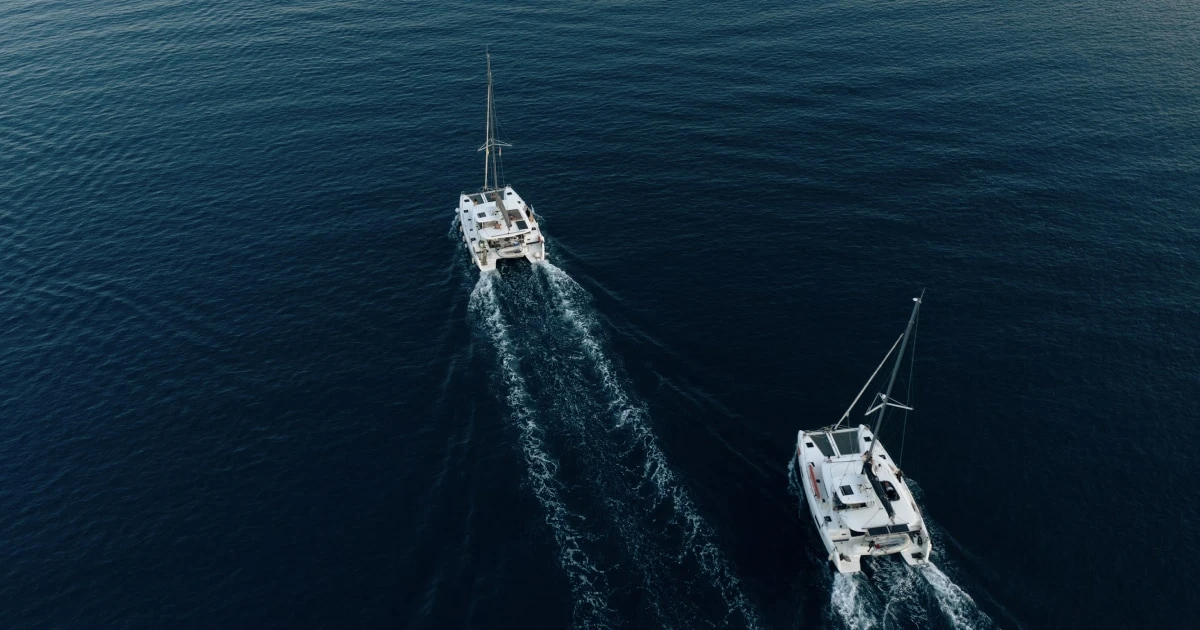
When two boats approach each other at sea, who should change course? What happens when a sailboat meets a motorboat? And what should you do if another vessel appears not to be taking action to avoid a collision?
The answers are governed by the COLREGs, the International Regulations for Preventing Collisions at Sea.
These rules establish how vessels should navigate in relation to one another. They cover lookout, safe speed, collision risk, crossing and overtaking situations, navigation lights, sound signals and restricted visibility.
Whether you sail a yacht, operate a motorboat or navigate a larger vessel, understanding the COLREGs is fundamental to safe boating.
This guide introduces the main principles and common encounter situations. It is not a substitute for the complete regulations, local navigation rules or practical training.
1. What are the COLREGs?
COLREG stands for the International Regulations for Preventing Collisions at Sea. The convention was adopted by the International Maritime Organization (IMO) in 1972 and entered into force in 1977.
The rules are commonly divided into several parts:
- Part A — General: application, responsibility and definitions.
- Part B — Steering and sailing: lookout, safe speed, collision risk, avoiding action and vessel responsibilities.
- Part C — Lights and shapes: the visual signals vessels must display.
- Part D — Sound and light signals: sound signals and other signals used for manoeuvring, warnings and distress.
- Part E — Exemptions: specific exemptions from certain requirements.
- Part F — Verification of compliance: provisions concerning compliance with the convention.
The rules are international, but national and local requirements may also apply. For example, some inland waters have additional or different navigation rules. Always establish which regulations govern the waters in which you are operating.
2. The fundamental rules every boater should know
Some COLREGs principles apply regardless of whether another vessel is crossing, overtaking or approaching head-on.
Rule 2: Responsibility
Compliance with the rules does not remove the responsibility to take appropriate precautions.
The circumstances of a situation, including the limitations of the vessels involved and any special dangers, must be considered. A skipper cannot rely blindly on a single rule while ignoring an obvious risk of collision.
Rule 5: Lookout
Every vessel must maintain a proper lookout by sight, hearing and all available means appropriate to the prevailing circumstances and conditions.
A good lookout means more than occasionally glancing around. You should:
- Scan the horizon and nearby waters regularly.
- Monitor vessels approaching from different directions.
- Listen for sound signals, particularly in restricted visibility.
- Use radar, AIS and other available equipment appropriately.
- Consider the limitations of electronic equipment and avoid relying on one source alone.
AIS can help identify and monitor equipped vessels, but not every vessel carries or transmits AIS. It does not replace a proper lookout.
Rule 6: Safe speed
Every vessel must proceed at a safe speed so that it can take proper and effective action to avoid collision and be stopped within an appropriate distance for the circumstances.
Factors to consider include:
- Visibility.
- Traffic density.
- Manoeuvrability and stopping distance.
- Background lights at night.
- Wind, sea state and current.
- Draft in relation to available depth.
- Radar limitations, where radar is fitted and used.
A speed that is safe in open water during daylight may be unsafe in a crowded harbour or in fog.
Rule 7: Risk of collision
Every vessel must use all available means appropriate to the prevailing circumstances to determine whether a risk of collision exists.
If there is doubt, the risk should be treated as existing.
A useful practical technique is to observe the other vessel’s compass bearing or relative direction repeatedly. If the bearing remains approximately constant while the distance decreases, there may be a collision risk.
Do not rely on this observation alone. Relative movement, the other vessel’s speed, your own manoeuvres and the limitations of visual estimation all matter. Use radar and other available means where appropriate.
Rule 8: Action to avoid collision
When action is required, it should be positive, made in ample time and consistent with good seamanship.
A manoeuvre should be large enough to be readily apparent to another vessel observing visually or by radar. A series of small, uncertain alterations can make your intentions difficult to interpret.
After taking action, continue monitoring the situation to confirm that the vessels will pass at a safe distance. Slowing down or stopping may be appropriate in some circumstances.
3. Give-way and stand-on vessels
In many encounters, the COLREGs identify one vessel as the give-way vessel and the other as the stand-on vessel.
These terms describe responsibilities, not an absolute right of way.
Give-way vessel
The give-way vessel must take early and substantial action to keep well clear of the other vessel.
In practice, this means:
- Recognising the situation early.
- Choosing a clear, effective manoeuvre.
- Avoiding last-minute changes when an earlier action is possible.
- Checking that the manoeuvre has successfully removed the collision risk.
Stand-on vessel
The stand-on vessel should normally maintain its course and speed so the give-way vessel can anticipate its movement.
However, this does not mean it must continue unchanged until a collision occurs.
When it becomes apparent that the give-way vessel is not taking appropriate action, the stand-on vessel must take action to avoid collision by its manoeuvre alone. It may also take action earlier when the rules permit or require it.
Important: Both vessels remain responsible for avoiding collision where the circumstances require it. Never assume the other skipper has seen you or will manoeuvre correctly.
4. The most common encounter situations
The rules for vessels in sight of one another include specific requirements for sailing vessels, overtaking, head-on situations and crossing situations.
Head-on situation: Rule 14
The rule applies when the vessels are power-driven and the circumstances meet the definition of a head-on situation. If you are in doubt about whether a head-on situation exists, the rules provide guidance on treating the situation accordingly.
Do not assume that every pair of approaching vessels is in a head-on situation. Their courses, aspects and the applicable rules must be considered.
Crossing situation: Rule 15
When two power-driven vessels are crossing with a risk of collision, the vessel that has the other on her own starboard side must keep out of the way and, if circumstances admit, avoid crossing ahead of the other vessel.
A useful memory aid is:
If the other power-driven vessel is on your starboard side, you will generally be the give-way vessel in a crossing situation.
This memory aid is not a substitute for the full rule. The relative positions, vessel types, restricted channels and other circumstances can change which rules apply.
Overtaking: Rule 13
A vessel overtaking another must keep out of the way of the vessel being overtaken.
An overtaking vessel is generally one approaching from a direction more than 22.5 degrees abaft the other vessel’s beam. At night, this corresponds to a position where the overtaking vessel would see the sternlight but neither sidelight of the vessel ahead.
If you are uncertain whether you are overtaking, you must assume that you are and act accordingly.
The obligation to keep clear continues until the overtaking vessel is finally past and clear. Do not assume the other vessel will change course to accommodate you.
Sailing vessels: Rule 12
When two sailing vessels are approaching one another with a risk of collision, Rule 12 establishes responsibilities based on their wind positions and tack.
- When the vessels have the wind on different sides, the vessel with the wind on her port side must keep out of the way of the other.
- When both vessels have the wind on the same side, the windward vessel must keep out of the way of the leeward vessel.
- If a vessel with the wind on her port side sees another sailing vessel to windward and cannot determine whether that vessel has the wind on her port or starboard side, she must keep out of the way.
These rules apply to sailing vessels under sail in the circumstances covered by the regulation. If a sailing vessel is using its engine, it may be treated as a power-driven vessel under the COLREGs, depending on its status and the applicable definitions.
Responsibilities between different vessel types: Rule 18
Rule 18 sets out responsibilities between vessels, subject to exceptions elsewhere in the rules.
In broad terms, a power-driven vessel underway must keep out of the way of certain vessels, including:
- A vessel not under command.
- A vessel restricted in her ability to manoeuvre.
- A vessel engaged in fishing.
- A sailing vessel.
The precise obligations depend on the vessel’s status and the circumstances. Vessels constrained by their draft also have a specific status under the international rules, and other provisions may affect the encounter.
Do not reduce Rule 18 to a simple hierarchy. The definitions, exceptions and other applicable rules must be considered before deciding which vessel must manoeuvre.
5. Narrow channels and traffic separation schemes
Some waters require additional navigation discipline because vessels have limited room to manoeuvre or follow organised traffic routes.
Rule 9: Narrow channels
Vessels navigating along a narrow channel or fairway must comply with the specific requirements of Rule 9.
Among other provisions, a vessel proceeding along the course of a narrow channel or fairway should keep as near to the outer limit of the channel or fairway on her starboard side as is safe and practicable.
Small vessels and sailing vessels must not impede the passage of vessels that can safely navigate only within the channel or fairway, subject to the wording and conditions of the rule.
A skipper should plan ahead, monitor traffic and avoid manoeuvres that could leave insufficient room for another vessel to pass safely.
Rule 10: Traffic separation schemes
Traffic separation schemes organise vessel movements into designated traffic lanes and separation zones.
When using a scheme, vessels must follow the relevant rules for entering, leaving, crossing and navigating within it. A vessel crossing a traffic lane should do so as nearly as practicable at right angles to the general direction of traffic flow, as required by Rule 10.
A recreational boat should not assume that a traffic separation scheme is simply a marked route to follow at any angle. Check the chart, understand the scheme and minimise interference with vessels using the lanes.
6. Navigation lights and shapes: Rules 20–31
The COLREGs specify the lights and shapes vessels must display to communicate their status and activity.
These signals help other vessels understand whether a boat is power-driven, sailing, fishing, towing, anchored or experiencing restricted manoeuvrability.
Examples include:
- Power-driven vessels underway: prescribed masthead light or lights, sidelights and sternlight, depending on vessel length and configuration.
- Sailing vessels underway: sidelights and a sternlight, with specific permitted arrangements and additional lights in certain circumstances.
- Vessels at anchor: prescribed anchor light or lights and, where required, shapes.
- Vessels not under command: prescribed red lights and shapes.
- Vessels restricted in their ability to manoeuvre: prescribed red-white-red lights and corresponding shapes, subject to the rules.
- Vessels engaged in fishing: specific lights and shapes according to the activity and conditions.
The exact requirements depend on vessel type, length, activity and circumstances.
For a practical explanation of the lights you may see at sea, read Boat Navigation Lights Explained.
Lights are not only for night navigation. The COLREGs contain requirements for lights and shapes in different conditions, and local regulations or the specific circumstances may impose additional obligations.
7. Sound signals and restricted visibility
The COLREGs also prescribe sound signals, including signals for manoeuvring, warning and restricted visibility.
Sound signals are especially important when vessels cannot see one another clearly. Their meaning depends on the signal, the vessel’s status and the circumstances.
In restricted visibility, Rule 19 applies to vessels that are not in sight of one another when navigating in or near an area of restricted visibility.
Key principles include:
- Proceed at a safe speed adapted to the conditions.
- Keep engines ready for immediate manoeuvre when required for a power-driven vessel.
- Use radar appropriately and assess whether a risk of collision exists.
- Take avoiding action when required, while accounting for the limitations of radar information.
- If a fog signal is heard apparently forward of the beam, or a close-quarters situation with a vessel forward of the beam cannot be avoided, reduce speed to the minimum at which the vessel can be kept on course, take all way off if necessary and navigate with extreme caution.
Do not treat fog signals as a replacement for lookout, radar assessment or other precautions.
For a more detailed explanation, read Rule 19: Collision Avoidance in Restricted Visibility.
8. A practical COLREGs checklist
Use this checklist when approaching other vessels or entering busy waters.
- Maintain a proper lookout by sight, hearing and all appropriate available means.
- Choose a safe speed for visibility, traffic, manoeuvrability and conditions.
- Assess collision risk early and continue monitoring the situation.
- Identify which rules apply: crossing, head-on, overtaking, sailing-vessel encounter or another situation.
- Determine whether your vessel must give way or stand on.
- If required, take early, substantial and readily apparent action.
- Confirm that the manoeuvre has created a safe passing distance.
- Display the correct navigation lights and shapes.
- Use the prescribed sound signals when applicable.
- In restricted visibility, apply Rule 19 and take additional precautions.
- Follow local regulations, traffic separation schemes and instructions from the relevant authorities.
9. Record your navigation and incidents in a boat logbook
Understanding the COLREGs is part of safe navigation, but reviewing what happened during a trip can also help you improve your decision-making.
A boat logbook can record useful context such as:
- Date, time and position.
- Weather, wind and visibility.
- Route and GPS track.
- Encounters with other vessels that were relevant to the trip.
- Safety warnings or instructions received.
- Any incident, manoeuvre or lesson worth reviewing.
If an incident occurs, record facts as accurately as possible, including the sequence of events, the vessels involved, relevant conditions and actions taken. Distinguish observations from assumptions, and preserve any other records that may be relevant.
With Skipper, you can document boating trips with GPS tracks, locations, notes and photos, then review your trip history later.
Conclusion
The COLREGs provide the shared framework that allows vessels to navigate safely around one another. The most important starting points are to maintain a proper lookout, proceed at a safe speed, assess collision risk early and take effective action when necessary.
Learn the rules that apply to your vessel and navigation area, and do not rely on simplified rules of thumb when the situation is complex. The stand-on vessel is not guaranteed an unconditional right of way, and every skipper must continue to act responsibly to avoid collision.
Safe navigation depends on understanding the rules, applying them in context and staying alert to what other vessels are doing.
Frequently asked questions
What does COLREG stand for?
COLREG stands for the International Regulations for Preventing Collisions at Sea. These rules establish internationally agreed requirements for vessel conduct, collision avoidance, lights, shapes and sound signals.
Which vessel has right of way at sea?
The COLREGs do not provide an unconditional right of way. They define which vessel must keep out of the way and which should normally maintain course and speed. Both vessels must still take appropriate action to avoid collision when the circumstances require it.
What is the difference between a give-way vessel and a stand-on vessel?
The give-way vessel must take early and substantial action to keep clear. The stand-on vessel should normally maintain course and speed, but must act when it becomes apparent that the give-way vessel is not taking appropriate action.
What should I do in a head-on situation?
When two power-driven vessels meet on reciprocal or nearly reciprocal courses with a risk of collision, each should alter course to starboard so they pass port-to-port, unless the circumstances or applicable rules require otherwise.
Do the COLREGs apply to recreational boats?
Yes. The international rules generally apply to vessels on the high seas and connected navigable waters. Local and inland rules may also apply, so boaters must know the regulations relevant to their location.
Remember your days at sea
Skipper is a ship’s log app for sailboats and powerboats, available on iPhone and iPad. It records every trip with GPS and keeps your whole sailing history in one searchable logbook. Free for your first three trips.

Keep reading
Boat Navigation Lights Explained
Learn how to identify boat navigation lights, understand what they reveal about a vessel, and recognise the lights required at night and in restricted visibility.
All boaters
How to Take a Bearing at Sea
Learn how to take a compass bearing, identify landmarks, plot position lines, and use multiple bearings to estimate your position at sea.
All boaters
IALA Buoyage System: A and B
Learn how to identify IALA navigation buoys and marks, understand Regions A and B, recognise cardinal marks, and navigate safely through marked channels.
All boaters