 Skipper
Navigate
•All boatersHow to Pick Up a Mooring Buoy
Learn how to approach, pick up and secure a mooring buoy safely, with practical steps for sailboats and motorboats.
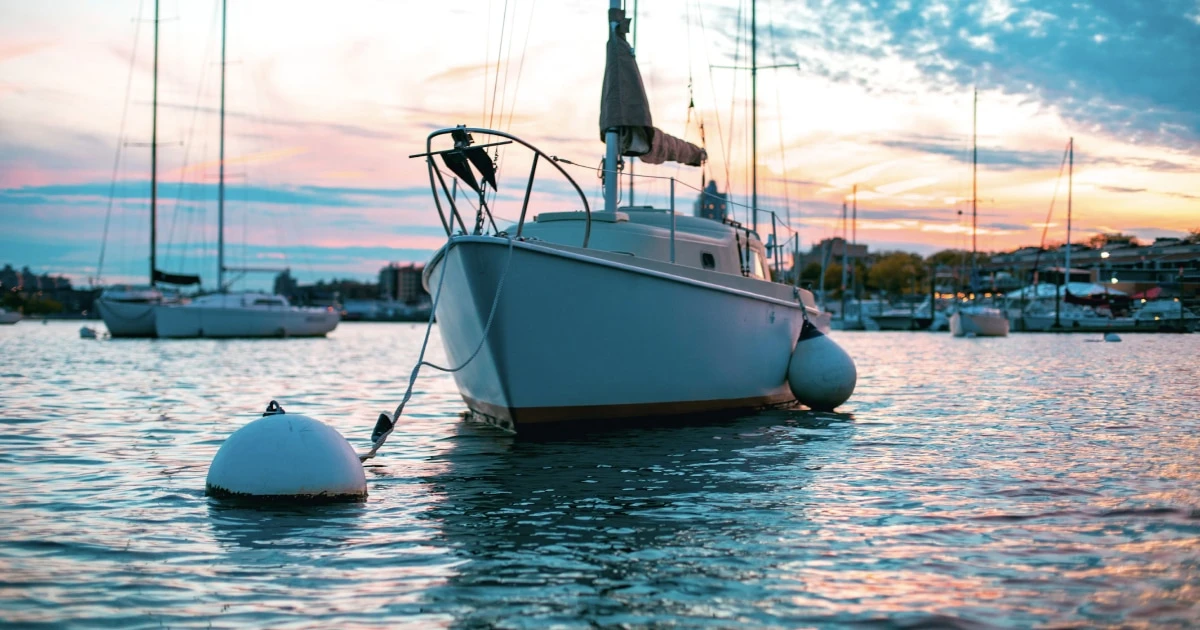
How to Pick Up a Mooring Buoy
Picking up a mooring buoy should be a controlled manoeuvre, not a race to grab a floating ball before the boat drifts past it.
The key is to prepare your lines, understand the wind and current, approach at low speed, and secure the boat without putting anyone at risk. The same principles apply to sailboats and motorboats, although the exact manoeuvre depends on the vessel, the mooring setup and local conditions.
This guide explains how to prepare, approach, pick up and secure a mooring buoy safely.
What Is a Mooring Buoy?
A mooring buoy marks a connection to a mooring system on the seabed. The system typically includes a heavy anchor or sinker, a chain or riser, and a surface buoy with a ring, pennant or pickup line.
Instead of deploying your own anchor, you attach your boat to the designated mooring connection.
Moorings can be useful in busy anchorages, managed bays and areas where anchoring is restricted or undesirable. However, not every buoy is available for public use, and not every mooring is suitable for every boat.
Before approaching, establish:
- Whether the mooring is public, private, reserved or available for a fee.
- Whether your boat’s length, displacement and draft are within the permitted limits.
- Whether the water is deep enough throughout your intended stay.
- How the mooring is designed to be picked up and secured.
- Whether local restrictions or environmental protection rules apply.
If you cannot confirm that the buoy is suitable and available, do not assume you can use it.
1. Prepare Your Boat and Crew
Preparation makes the actual pickup much easier. Do as much as possible before entering the immediate area around the buoy.
Prepare the mooring line
Have a suitable mooring line ready at the bow, or rig it according to the pickup method you intend to use.
Check that:
- The line is long enough for the arrangement and conditions.
- It is free of knots and tangles.
- It can run freely through the intended fairlead or bow roller.
- The attachment point on the boat is appropriate for the expected load.
- The line will not pass underneath the hull or near the propeller.
If the mooring has a pickup buoy and pennant, identify how they connect to the main mooring. A small pickup line is often designed to help retrieve the heavier pennant; it should not automatically be treated as the permanent load-bearing connection.
Assign crew roles
Agree on a simple plan before manoeuvring.
- Helm: controls the approach, speed and stopping distance.
- Bow crew: uses the boat hook to retrieve the pickup line or buoy and secures the mooring line.
- Additional crew, if available: communicates distances, watches surrounding traffic and helps the helm understand the boat’s position.
The helm may lose sight of the buoy as it approaches the bow. Clear distance calls and agreed hand signals can help.
Everyone should know what to do if the pickup is missed. Keep crew inside the boat and away from unsafe positions over the bow or side. Wear suitable personal flotation devices, and never wrap a line around a hand or body part.
2. Assess the Wind, Current and Surroundings
Before committing to the approach, observe the conditions around the mooring.
Wind and current may act in different directions. Look at the movement of the pickup buoy, the direction in which nearby boats are lying, and any visible movement of floating objects. Nearby boats provide useful clues, but they do not necessarily show the exact effect of wind and current on your own vessel.
Also check:
- Water depth and any nearby shallow areas.
- Other boats, swimmers, rocks and navigational hazards.
- The space available to turn away if the manoeuvre fails.
- Whether the mooring itself appears damaged or poorly maintained.
When possible, make a reconnaissance pass to understand the buoy’s attachment points and the conditions around it.
3. Choose Your Approach
A common starting point is to approach slowly against the dominant force affecting the boat: usually the wind or the tidal current, whichever has the greater practical effect.
This helps you control the boat’s movement and stop near the buoy. The ideal approach angle depends on the boat, wind, current, visibility and surrounding traffic.
Use the following principles:
- Approach from a position that gives you room to manoeuvre.
- Keep the buoy in view for as long as possible.
- Maintain only enough speed for reliable steering.
- Avoid passing between the main mooring buoy and its pickup buoy or line, where a line could become caught around the keel, rudder or propeller.
- Keep an escape route available if you pass the buoy or cannot reach it.
Do not assume that the boat’s speed over the ground tells you how much water is flowing past the hull. In a current, speed over the ground and speed through the water can differ significantly.
The goal is to bring the pickup point within safe reach just as the boat’s forward movement is reduced to a minimum.
4. Pick Up the Buoy
The exact sequence depends on the mooring arrangement. Some have a small pickup buoy attached to a pennant; others have a ring or eye through which you must pass your own line.
If the mooring has a pickup buoy and pennant
- Approach at low, controlled speed with the crew ready.
- Use the boat hook to retrieve the small pickup buoy or its line.
- Bring the pennant aboard carefully, keeping it clear of the propeller and other moving equipment.
- Identify the designated attachment point and check the pennant for obvious damage.
- Transfer the load to the proper mooring line and secure it to a suitable strong point on the boat.
Do not rely on a thin pickup line as the permanent mooring connection unless the mooring’s instructions explicitly identify it as load-bearing.
If the buoy has a ring or eye
- Prepare an appropriate mooring line before approaching.
- Retrieve the buoy with a boat hook when it is safely within reach.
- Pass the line through the designated ring or eye, following the mooring’s instructions.
- Secure the line to an appropriate bow cleat or other approved strong point.
- Check that the line is correctly led and cannot chafe excessively against an edge.
The best arrangement can vary with the mooring design and the expected length of stay. Follow the operator’s instructions where provided.
Keep hands and feet clear
Never put a hand or foot between the buoy and the hull. Do not lean dangerously over the side, jump into the water to retrieve a line, or try to stop a moving boat by holding the mooring line by hand.
If the buoy is out of reach, let it go and manoeuvre around for another attempt.
5. Secure the Boat Properly
Once the connection is made, confirm that the mooring line is secured correctly before relaxing the manoeuvre.
Check the following:
- The line is attached to the intended mooring connection.
- The boat’s line is secured to a suitable cleat or strong point, not a lifeline, guardrail or other unsuitable fitting.
- The line is led through the correct fairlead or bow roller.
- The line is not caught around the propeller, rudder, keel or other underwater equipment.
- The line has no obvious damage, severe chafe or unsafe knots.
- The boat has room to swing without hitting nearby boats or obstacles.
Ease the boat back gently as appropriate to the setup, allowing the mooring system to take the load progressively. Avoid applying unnecessary engine power against the mooring.
For a longer stay or in conditions that could increase loads, check whether a second line is appropriate. Use a suitable attachment arrangement that avoids chafe and does not interfere with the primary connection. Follow local guidance and the mooring operator’s instructions.
Do not assume that a buoy is secure simply because the boat is attached to it. Mooring systems can fail, and a visual check from the boat cannot guarantee the condition of the underwater tackle.
6. Check the Boat After Pickup
Once secure, take a moment to assess the situation.
Check your position
Confirm that you are clear of nearby boats and that the boat has enough room to move as wind and current change.
Check depth and conditions
Recheck the depth for the expected duration of your stay, taking the tide into account where relevant. Review the forecast and consider whether changing conditions could make the mooring unsuitable.
Check the line
Look for chafe, excessive tension, an awkward lead or contact with sharp edges. Recheck the arrangement after the boat settles and whenever conditions change.
Monitor your position
Observe how the boat moves relative to nearby fixed references and neighbouring boats. If you suspect the mooring is dragging or failing, take appropriate action promptly and move to a safer location if possible.
For an overnight stay, follow local requirements for lights and other signals, and maintain a suitable watch for the conditions.
What If You Miss the Mooring Buoy?
Missing the buoy is not a reason to rush or make a sharp, last-minute manoeuvre.
Instead:
- Continue into the space you identified as safe during your approach plan.
- Keep clear of other boats and any mooring lines.
- Reassess the wind, current and your approach angle.
- Brief the crew again if the plan changes.
- Make another attempt only when the boat is under control and the pickup is safe.
If the conditions are too difficult, the buoy is unsuitable, or you cannot safely control the approach, abandon the attempt. Consider another available mooring or a suitable anchorage where anchoring is permitted.
Common Mistakes When Picking Up a Mooring
Avoid these common errors:
- Approaching too fast. The boat may be difficult to stop before passing the buoy.
- Ignoring the current. Wind alone may not determine the boat’s movement.
- Leaving the lines until the last moment. Untangling a line during the approach creates unnecessary pressure.
- Passing over the pickup line. A line can foul the propeller, rudder or keel.
- Using the wrong attachment point. Lifelines and guardrails are not suitable substitutes for proper mooring cleats.
- Treating the pickup line as the main mooring line. Check the system’s design before transferring the load.
- Continuing after a failed approach. Use your escape route and try again when conditions are under control.
- Assuming every buoy is safe and available. Confirm permission, suitability and visible condition before using it.
Mooring Buoy Pickup Checklist
Use this quick checklist before and after the manoeuvre.
Before approaching
- Confirm permission to use the mooring.
- Check vessel limits, depth and local restrictions.
- Assess wind, current and surrounding traffic.
- Prepare the mooring line and boat hook.
- Brief the crew and agree on communication.
- Identify a safe route to abort the approach.
During pickup
- Approach slowly against the dominant force where practical.
- Keep the buoy and pickup line clear of the propeller.
- Retrieve the correct line or attachment point.
- Keep crew clear of pinch points and unsafe positions.
- Secure the boat to an appropriate strong point.
After pickup
- Check the line, attachment and lead for chafe.
- Confirm adequate depth and swinging room.
- Monitor the boat and surrounding conditions.
- Reassess the setup if wind, current or sea conditions change.
Record Your Stop with Skipper
A mooring stop is part of your boating history, just like a passage or an anchorage. Recording where you stopped, the conditions you experienced and any useful notes can help you remember the trip and review it later.
With Skipper, you can record your boating trips, keep GPS tracks, add locations, weather details, notes and photos, and revisit your trip history on a map.
Whether you are building confidence with boat handling or keeping a record of longer passages, a consistent log can make each trip easier to review.
Frequently Asked Questions
What is the difference between anchoring and picking up a mooring buoy?
When anchoring, you deploy your own anchor and rode to hold the boat on the seabed. When picking up a mooring, you secure the boat to a buoy connected to a permanent or managed underwater mooring system.
Should you approach a mooring buoy into the wind or the current?
Approach slowly against the dominant force affecting your boat, usually the wind or the tidal current. Assess both before manoeuvring, because their effects can differ. The correct approach also depends on the boat and the available space.
Where should you attach a mooring line?
Use the designated ring, pennant or attachment point on the mooring, following the local instructions. Secure the line to a suitable bow cleat or approved strong point, not to lifelines or guardrails.
Can you use any mooring buoy you find?
No. Check that the mooring is available for your use, that your vessel fits its limits, and that local rules permit you to use it. Some moorings are private, reserved or restricted to specific vessel sizes.
What should you do if you miss the mooring buoy?
Continue into a safe area, reassess the conditions and try again only when the boat is under control. Do not make a rushed turn or pass over the pickup line. If the manoeuvre is unsafe, abandon it and choose another suitable option.
Is picking up a mooring buoy different for a sailboat and a motorboat?
The core principles are the same: assess conditions, plan the approach, reduce speed, retrieve the correct line and secure it properly. The boat’s handling characteristics and the method used to control its movement will differ. Sailing onto a mooring requires additional boat-handling skill and should only be attempted when conditions and crew competence make it safe.
Related Articles
Remember your days at sea
Skipper is a ship’s log app for sailboats and powerboats, available on iPhone and iPad. It records every trip with GPS and keeps your whole sailing history in one searchable logbook. Free for your first three trips.

Keep reading

How to Anchor a Boat
Learn how to choose an anchorage, deploy an anchor, calculate anchor scope, check holding, and monitor your boat safely.
All boaters
How to Keep Anchor Watch
Learn how to keep a proper anchor watch, check whether your anchor is holding, monitor weather and wind shifts, and respond if your boat starts dragging.
All boaters
Mediterranean Mooring: A Step-by-Step Guide
Learn how to moor stern-to in a Mediterranean harbour, using your own anchor or a lazy line, with practical steps for preparation, approach and securing the boat.
All boaters